Showing posts with label Buddhism. Show all posts

Monday, 15 November 2010

Nan Lian garden & Chi Nin Nunnery... Oasis in the city


An oasis in Kowloon

I don't think many of my Hong Kong friends have been to Nan Lian garden nor Chi Nin Nunnery. I didn't even know of its existence until I spoke to a friend in the U.S. and she mentioned her surprise when she saw a 'Kyoto-like' garden in the middle of Kowloon. Diamond Hill is not a touristy nor particularly interesting area, so I was also surprised to find out that the garden is located in an area full of housing estates.

Honestly, places like this garden and nunnery are rare in Hong Kong. It's always quite puzzling to see the Hong Kong tourism association promoting attractions such as Ocean Park or Disneyland to foreign tourists. Apart from tourists from Mainland China, I doubt Westerners are interested in going to Western theme parks here!

Nan Lian garden

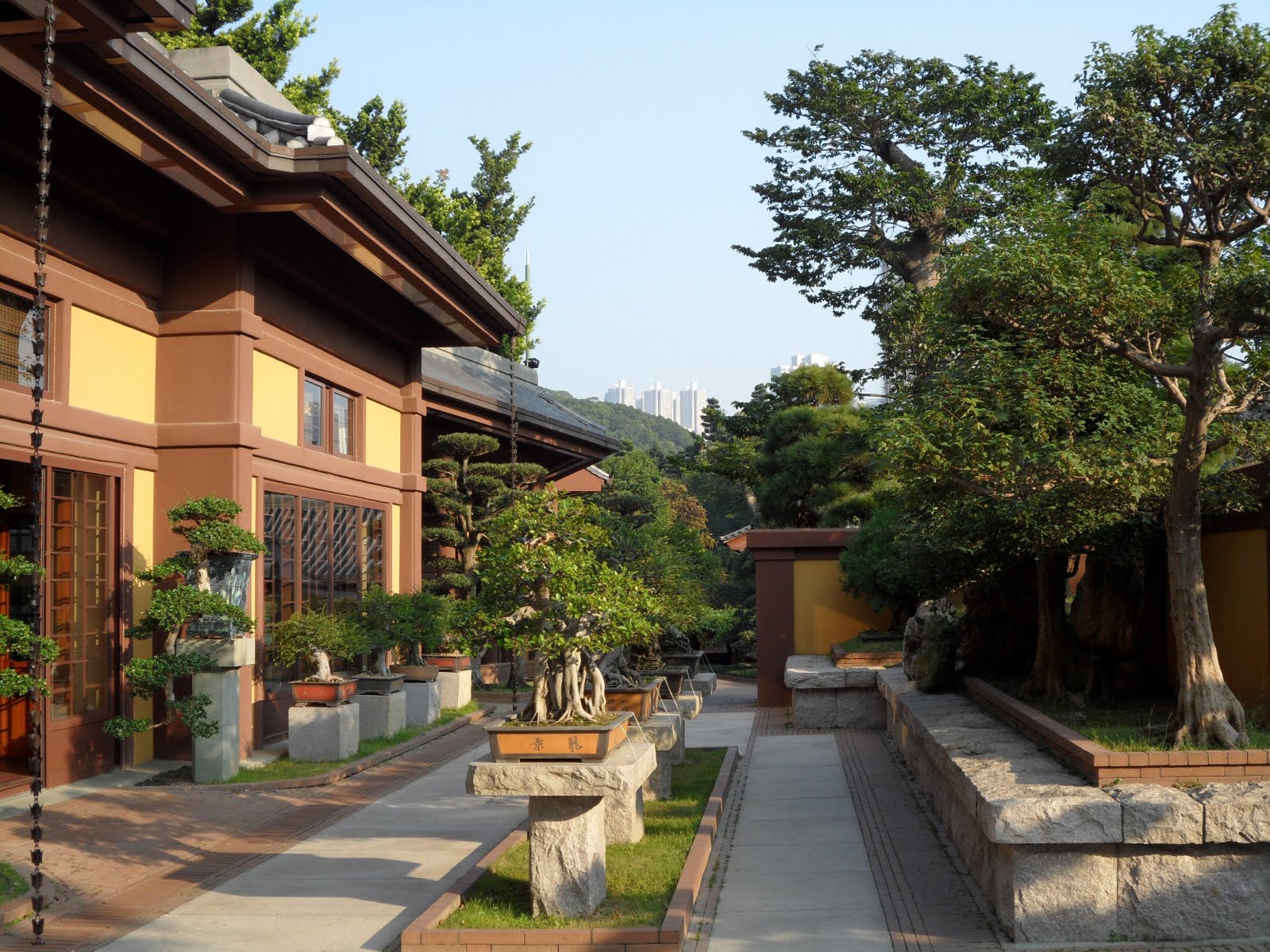
Opened in 2006, the landscape garden is built in the classical style of the Tang Dynasty (618 AD to 907 AD). Although it is relatively new, it doesn't feel like 'Disneyland', the garden landscape is quite low-key and blends surprisingly well with the high rise backdrop. Walking through the garden, my attention turned to the fascinating plants, trees and rocks, which made me feel tranquil and calm (mind you, I was there on a weekday!). Besides, it's all free!

There are other facilities such as Chi Lin vegetarian restaurant (serving good seasonal food, best for mushroom l), a small cafe (serving surprisingly good coffee and pine nuts cookies), a souvenir shop (which sells interesting souvenirs), a tea house and exhibition halls.


Entrance of the garden, minutes from the MTR station


Chi Lin vegetarian restaurant behind the man-made waterfall


Tea house & Blue Pond


Watermill


Pavilion of Absolute of Perfection


Plants & rocks in the garden


Penjing Garden


The Rockery


Chi Nin Nunnery

The Nunnery was founded in 1934 but the rebuilting of the current temple complex started in 1992 and eventually completed in 2000. Based on the style and construction techniques of traditional Chinese architecture from the Tang Dynasty, special interlocking system was used instead of iron and nails. Unlike some traditional Chinese temples that are 'loud' and over-decorative, this temple complex is surprisingly subtle, tranquil and sophisticated. This has to be one of the most impressive Chinese temples that I have ever visited despite it being quite new. From its architecture style, I can see the Tang influence on Korean and Japanese Zen Buddhist temples... I think both the Nunnery and the landscape garden should be on the all tourists' itineraries! Simply remarkable!


Lotus pond


A view of Nan Lian garden from the Nunnery

Tuesday, 9 November 2010

Thich Nhat Hanh retreat in Hong Kong 2010


Thay taking a rest and drinking a cup of tea mindfully during the walking meditation


Thay leading the last walking meditation


Sun finally came out after the rain...


Accommodations


Our room

My friend and I wanted to go to Zen Master Thich Nhat Hanh's retreat in Nottingham back in August but was put off by the high price (almost £500!), so we went to his talk in London instead. Although I was disappointed, I kinda put it aside without much thought. A month later, I told my Hong Kong friend that I was going to be in town during November, and to my surprise, she informed me that Thay was also visiting, and she had just signed up for the retreat. I couldn't believe my luck... but the most shocking thing was the cost of the retreat... only £100! Not sure why there was such a huge difference in the pricing but I definitely was glad to attend and save a few hundred pounds at the same time!

Last New Year, I went on my first major Buddhism/ meditation retreat with over 100 people in the U.K. and the experience taught me a lot about myself and others. While I was there, I struggled to focus and encountered many inner conflicts, but the impact was huge and I remained positive for almost 2 weeks after the I left the retreat! With this experience, I was more prepared this time and thus coped pretty well with over 1400 retreaters!

The differences between the two retreats: 1. Most people on this retreat were already familiar with either Thay's teaching or had acquired some basic understanding of Buddhism, so their attitudes were very different from those in the U.K. who were driven by curiousity. 2. And because of this, people on this retreat were not as sociable and friendly as those in the U.K. (this could also be due to the culture differences). 3. And to my surprise, the sitting meditations were relatively short and infrequent because the emphasis was more on walking meditations which I quite like.

The common ground of the two retreats: 1. Both with very basic facilities, it could be quite challenging being out of our comfort zones esp. in terms of cleanliness or if you are not used to the food. 2. Both were packed with activities from dusk til dawn, so it could be extremely tiring esp. when you are not used to getting up at 5.30 in the morning and going to bed after 10 every night! 3. Similar programmes with talks, sharing, silence, yoga (or other exercises)... however, my friend and I particularly liked 'Total relaxations' where we could take afternoon naps... brilliant idea!

Of course, the best thing about this retreat was the presence of Thay. It was a rare sight to see 1. Over 1000 Hong Kong people sitting quietly on floor mats with their mobiles turned off (although there were some who did not do this) listening to Thay talking for 2 hours every morning! 2. Grown men and women singing accompanied by cute hand gestures! 3. Usually monks and nuns seem serious and rigid but here, the 80 monks and nuns looked joyful and full of spirits!

And during the first two days, it was pouring down continuously but we went ahead with the walking meditation on the second morning. While most of us had umbrellas, a few had to use towels, yoga mats and hats to cover their heads! It was rather touching to see Thay leading in front and over a thousand people following him in such miserable weather. The power of faith and respect left a strong impression on me.

As expected, there were quite a few minor issues and my friend and I strongly felt that the organizer had accepted too many retreaters or commuters because we were packed like sardines most of time! However, most of us left the retreat more postive and joyful because Thay's kindness, insights, wisdom and sense of humour really touched us all. He even inspired me to take part in the transmission of the five mindfulness training which I hope will help me to become a kinder and more mindful person...


The equally peaceful world outside of the retreat gates...

Friday, 17 September 2010

Deloitte Ignite 2010 @ Royal Opera House (5th September)


‘Faded Forest’ at the Crush bar

The third annual Deloitte Ignite at the Royal Opera House was curated by Joanna MacGregor, an internationally renowned pianist, composer and auteur. I didn't manage to wander into every room but from what I saw, I think this year's forest-inspired theme and installations were more appealing and successful than last year's, the overall tone was grander, more theatrical but also organic at the same time.

Richard Williams and David Collis' ‘Faded Forest’ at the Crush Room was mesmerising. Using discarded opera costumes, they created a fairytale like ambience and together with the opera performance, I felt like I was in a time warp! Amazing!

In the Paul Hamlyn Hall, 'Floating Forest', an installation made of organic materials and projections was created and built by artists Dan Fern, Sophie Clements, Johannes Braun and Toby Cornish (together with students and graduates of The Royal College of Art). In evening performance, different coloured lights were projected onto the installation creating quite an enchanting effect.

'Monastery of sound' performance by Tashi Lhunpo Monks of Tibet
The closing performance by the remarkable Tashi Lhunpo Monks of Tibet was the highlight of the event. The monks, dressed in traditional costumes performed sacred dances, chanted, prayed and debated (in their rather unusual style). Their music created by instruments like Dungchen (long horns), Gyangling (oboes), the Dhamaru (a small hand-held drum) and the Drilbu (bell) was unique and meditative. I thought the 'Floating Forest' and ambience of the Royal Opera House merged very well with the sound of the monks. Again, the music and sounds made me feel like I was in Tibet (or India where the monks are based since the Chinese government took over Tibet) rather than Central London!

The only down point was the seating arrangements... since the stage was low and all the seats were the same height, audiences at the back just couldn't see properly, so most ended up either standing or moving towards the back. A bit of a shame but hopefully they will improve on these details next year.


An installation at the entrance


'Floating Forest' in the Paul Hamlyn Hall


Recycled opera costumes as installations inside the Crush bar


An energetic performance by the Phoenix Dance Theatre group

Friday, 13 August 2010

Thich Nhat Hanh

A few years ago, when I was going through a very difficult and distraught period, I came across a name, Thich Nhat Hanh, the well-respected Zen Buddhist master of our generation. At the beginning, I couldn't even pronounce his name properly but I bought his books hoping to find some inner peace. Only later did I realised that it was probably the turning point of my life and nothing would ever be the same again.

I have always believed that 'things happen for a reason' and 'people come into our lives not by chance', so I see my encounter with Buddhism as a 'revelation' or my 'path'. It was through 'Thay's' (meaning Master in Vietnamese) books that I learnt to forgive, to make peace with myself and appreciate what I have.

This week, I went to see the Master at Hammersmith Apollo and was glad to see the venue packed with people of all ages. The evening started off with a short period of sitting meditation which allowed my mind and body to calm down before the talk. Just as I expected, 'Thay' is calm, gentle and has an amazing presence, his talk on mindfulness aims to incorporate into our daily lives, regardless of religions and backgrounds. The best part of the evening was the Q & A session because he answered every question with patience, clarity and humour. I love the way he traced the origin of bread and related it back to the cosmos!

A talk full of insights and wisdom, and you don't need to be a Buddhist to understand his teachings. It is all about awareness, being mindful of the present moment, of our actions, words and their impact on others. As he mentioned in the talk, one Buddha is not enough, we all need to be less selfish and care more about the future of humanity and our planet.

Recommendated books: Peace is Every Step: The Path of Mindfulness in Everyday Life and The Art of Power

Sunday, 10 January 2010

A prayer for the new decade...

I am not a religious person. I attended Christian/ Protestant schools all my life but have never felt any strong sense of connection towards Christianity. I used to pray almost daily when I was a kid but it was for all sorts of selfish reasons i.e. I will be good if God can make my stomach pain goes away etc. It was quite silly and I gave up praying as I turned into a teenager. Then in my early 20s, I became interested in Buddhism and New age spirituality. I read books by Shirley Maclaine about her spiritual journey and was completely fascinated by the subject. At the same time, I also became interested in meditation, tarot cards, astrology, Chinese astrology & fortune telling... But just like a fashion fad, my interests came and went quite quickly. I guess I was too young and hedonistic to truly understand and sustain my interests.

Until about 2 years ago, I really thought I knew what happiness was... I have had a pretty good life, financially secured, happily married with family and friends who love and care for me. I was enjoying life to the fullest... dining in Michelin starred restaurants, traveling leisurely on regular basis and staying at some of the best hotels in the world. Then suddenly everything started to crumble right in front me (including myself), and I couldn't stop it. I was completely helpless, and during the most difficult time, I turned to psychotherapy, Buddhism and meditation for support.

After a few months of psychotherapy sessions and endless of self-help books, I realised that they were just short-term solutions. In order to heal properly, I started to meditate daily and read books on Buddhist teachings. Two years on and I can say that I am more positive, focus and content. My happiness does not come from external sources but from within. Although I still enjoy certain luxuries and nice meals occasionally, I know that they are not essential to me. I don't like to be labeled as a 'Buddhist', but to me, Buddhist teachings make sense and they help me to become a better person. For the past year or so, my life has changed gradually and positively, and I know that I could never go back to the hedonistic way of living again.

Over the New Year, I spent days at a meditation retreat with hundred of strangers and it turned out to be the most meaningful and unique New Year I have ever had in my life. I have never liked New Year's eve because of the expectations, I have spent the past New Years around the world... in spa hotel, upscale restaurants, dinner parties, house parties, private clubs, night clubs and even at home, but they were all dull and pointless. Hence I was determined to change all that this year esp. because it was the end of a decade. All my friends and family looked at me funny when I announced my New Year plan, but when they saw how positive and energetic I was afterwards, they began to understand why I did it.

After being cut off from the outside world for days, I couldn't watch the news when I got home because everything was so negative. The world didn't change THAT much over those few days, but my mindset did. We had generated so much positive energy between us that I became ultra sensitive to anything negative. Although personally I feel more positive about my future, realistically, I don't feel the same way about the future of this world.

We are now living in a very dangerous world, not only it is more divided than ever in terms of race, religions and wealth, we are also facing a crisis in our ecosystem. Most people in the wealthy and developed nations are more concerned with their economies, but personally I think this crisis is just what we need after years of prosperity. It is now the time to reflect and look inwards. If we want to make the world a better place, we need to start within ourselves. We need to re-evaluate our values, goals and purposes. Most people claim that their ultimate goal in life is to be happy, but what does happiness mean? Is it to find Mr Right, have some kids and live in a suburban house with a garden? Is it to become the CEO of a multi-billion dollar company? Or is it to win the X factor and become famous overnight? Yet why do so many of us still feel empty after achieving our goals?

In Buddhism, it is said that human sufferings are caused by desire. We humans don't seem to learn from our past lessons and we repeat the same mistakes over and over again. We believe that power, status, money, romantic love and beauty (all external factors) can bring us true happiness, and we want control over every aspects of our lives. But of course we always end up disappointed and disillusioned when things start to fall apart or are beyond our control. Why are people surprised about the collapse of the Western banking system and financial crisis in Dubai? To me, they seemed inevitable because people just got too greedy. And I can see this happening again in the future, especially in the up and coming countries like China, India, Brazil and Russia (In fact, Russia has also been affected by the recent economic crisis). Unless they learn from the mistakes made by the developed countries, they will not be exempt from similar crisis in the future.

My prayer for the new decade is that we, as human beings, must learn to control our desire, and we need to understand that instant gratifications do not bring us true happiness. Of course it is not realistic to try to abandon all our desire because we are not monks or nuns, but we need to know that being selfish and ignorant will get us nowhere and subsequently it will only cause more damage to our world/ planet. We all have the power to change the world and make things better, but we must start from within and then we can educate the next generation and hope that they can use their knowledge and power to do good in the years to come. I have no idea what will happen within the next ten years, but I will try my best to fulfill my role as a responsible citizen of this world.